EU “eHealth in Focus” Newspaper mentions Cyber18!
Direct Extract:
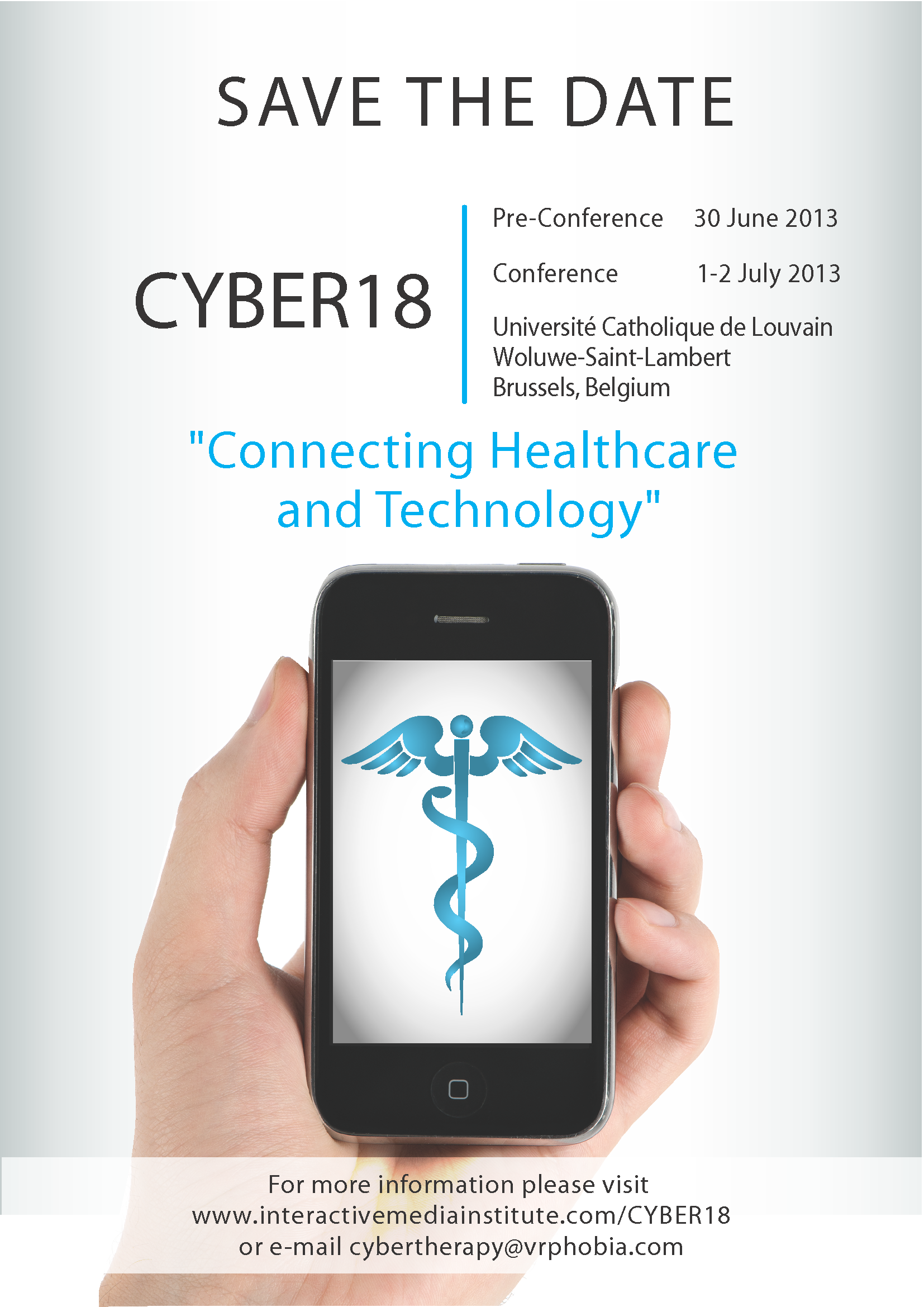
“From 30 June until 2 July 2013, the 18th Annual CyberPsychology & CyberTherapy Conference will take place. Topics include: electronic health coaching, using virtual reality in treatments (for example after hand surgery), the new EU research program Horizon 2020, virtual body swapping and advanced technologies in the assessment and evaluation of psychological stress.

CYBER18 has grown to a full-scale conference with presentations that demonstrate controlled clinical trials with unique applications of cutting edge technologies that improve the access and increase the quality of healthcare.

Prominent academic representatives from Europe, North America, and Asia will serve as Scientific Chairs and on its Scientific Committee.

Note in your agenda:

July 1 – Conference Day 1

Keynote Address: Robert Madelin (Director-General for DG CONNECT): “Cyber Everything in Horizon 2020”

July 2 – Conference Day 2

Innovations in Health and Well-Being – Chairs: Terje Peetso and Peteris Zilgalvis

“ICT to Prevent Citizens From Becoming Patients” – Peteris Zilgalvis (Head of Unit, ICT for Health and Wellbeing, DG CONNECT)

The EU funded INTERSTRESS Project: “Advanced Technologies in the Assessment and Evaluation of Psychological Stress” – Prof. Andrea Gaggioli, Istituto Auxologico Italiano, Italy

European Commission Funding Program: Francois Junique (Project Officer, DG CONNECT, Flagship unit) will present  “The Human Brain project” (HBP).

Find the full program of the conference here.”


Original link can be found here

Belgian Economic Mission to the United States

Brussels, Belgium (June 11, 2013) — The Virtual Reality Medical Center (VRMC) was selected to participate in the recent Belgian Economic Mission to the United States, organized by the Belgian Foreign Trade Agency in collaboration with the regional institutions Wallonia Foreign Trade & Investment Agency, Brussels Invest & Export, and Flanders Investment & Trade and FPS Foreign Affairs. The event, held from June 2 to June 9, 2013, was presided over by the Prince Philippe of Belgium, and consisted of 393 participants, bring together companies from various business sectors to expand their influence to the U.S. and promote trade between Belgium and the U.S.

Virtual Reality Medical Center uses simulation technologies in three main areas: 1) treating patients with stress, anxiety, and trauma, 2) training for military medical and civilian populations, and 3) enhancing medical educational programs. A Belgian corporation established in December 2006 with affiliates in the U.S. and China, VRMC principals are world leaders in applying VR technology in combination with physiological monitoring and feedback fro training, therapy, and emerging applications. We are also focused on developing a comprehensive protocol to address an array of needs for military personnel and civilian first responders as well as emerging technologies for various security and intelligence operations. Having been involved in R&D projects in Europe, Asia, and the U.S. for the past 25 years, we have won over 50 competitive government contracts and look now towards marketing the developed products and protocols.


Representing VRMC on the mission were Prof. Dr. Brenda Wiederhold, President, and Prof. Dr. Mark Wiederhold, Director of Clinical Research.

Social Media is Shifting Power from Advertisers to Consumers

In a recent Forbes.com column, Shel Israel opined, ‘‘Social media is not yet a vast wasteland.. But in the world, where changes come at the speed of the Internet, I see danger here.’’

When television was in its infancy, some of its pioneers sought to share fine arts with viewers, but advertisers quickly drove the decision makers to offer low comedy and variety shows. When social media was in its infancy, companies at first talked about listening to their products’ consumers, but now they are talking ‘‘about making social media more transactional rather than conversational.’’

Still, consumers push back, driving advertising budgets and media buys through their social media behavior. By the 2013 Super Bowl, some predict that advertisers will change less liked versions of their TV commercials to different ver- sions later in the game—for the first time making real time changes in the commercial lineup. This is based on the esti- mated 5 million viewers who tweeted or otherwise com- mented on the commercials during the 2012 Super Bowl, for which ads cost an average of $3.5 million.2 With $72 billion in U.S. television ad spending at stake,3 the once fanciful notion of ‘‘interactive TV’’ is becoming reality.

TV is still the primary communications channel for mar- keters, representing a 41% share of major media advertising spending globally in 2011, up from 38% in 2001, when In- ternet advertising was new.4 Advertisers are learning to put their TV commercials online, and it is paying off. Online au- diences watched ads a record breaking 1.3 billion times in the first quarter of 2012, an increase of more than 40% compared to the same period in 2011 and more than 225% compared to the same period in 2010.5

Paying attention to the convergence of TV and social media is critically important to advertisers, as Americans spend 20% of their day watching TV—and many are simultaneously playing with their iPad or iPhone.3 Research shows that 71% of tablet owners go online while watching TV; the extra device will soon not be needed, as all TVs are expected to be connected to the Internet, with more than three fourths of global TV shipments in 2015 having this capability.6

Research is beginning to appear to help advertisers un- derstand these interactions. Hanna et al. describe the social media ‘‘ecosystem’’ of digital and traditional media in their 2011 article.7 Hess et al. explore the interplay of TV, PC, and mobile technologies in the German home.8 And research by Onishi and Manchanda concludes that new and traditional media in Japan act synergistically in terms of market out- comes, with this relationship stronger during the prelaunch versus the postlaunch period for a new product.9

Certainly, more research is needed. Companies such as Bluefin Labs are using analytics to find out how context affects ad ‘‘buzz,’’ while recognizing that some processes are still a mystery. One ad appeared on two shows with similar demographics and ratings, yet one show created eight more times the social-media buzz than the other. Moreover, not everything is controllable, as social media users are not representative of the general population, and 90% of people’s conversations about brands happen offline.3

Experts in this emerging field believe that the relationship between advertisers and consumers is undergoing a funda- mental change. As Bluefin CEO Deb Roy put it, ‘‘Audience members speaking through social media is effectively a shift in power.’’3 Advertisers seeking to put that relationship back on a one way footing through ‘‘shouting’’ in social media ignore this power shift at their peril.
References
1. Israel S. (2012) Will marketing muck up social media? www.forbes.com/sites/shelisrael/2012/07/05/will-marketing- muck-up-social-media/ (accessed Jul. 15, 2012).
2. Talbot D. (2012) Why viewers could soon control Super Bowl ads. www.technologyreview.com/printer_friendly_ article.aspx?id = 39590 (accessed Jul. 15, 2012).
3. Talbot D. (2011) A social-media decoder. New technology deciphers—and empowers—the millions who talk back to their television through the Web. www.technologyreview .com/printer_friendly_article.aspx?id = 38910 (accessed Jul. 29, 2012).
4. Green A. (2011) Understanding television audiences. Warc best practice. www.ipsos-mori.com/Assets/Docs/Publications/ Understanding%20Television%20Audiences,%20September% 202011.pdf (accessed Jul. 29, 2012).
5. Visible measures. Q1 2012 social video advertising report. www.iab.net/media/file/SocialVideoAdvertisingReportQ12012 .pdf (accessed Jul. 29, 2012).
6. Mane S, Thompson K. How does industry buzz translate into real world consumer activity? Early indicators of what this means for advertising. www.iab.net/media/file/IAB_ Breakfast_Briefing_with_Ipsos_How_Does_Industry_Buzz_ Translate_into_Real_World_Consumer_Activity.pdf (accessed Jul. 29, 2012).

7. Hanna R, Rohm A, Crittenden VL. We’re all connected: the power of the social media ecosystem. Business Horizons 2011; in press. doi:10.1016/j.bushor.2011.01.007
8. Hess J, Ley B, Ogonowski C, Wan L, Wulf V. Understanding and supporting cross-platform usage in the living room. En- tertainment Computing 2012; 3:37–47.
9. Onishi H, Manchanda P. Marketing activity, blogging and sales. International Journal of Research in Marketing 2012; in press. doi:10.1016/j.ijresmar.2011.11.003


Brenda K. Wiederhold

Editor-in-Chief

http://www.liebertpub.com/overview/cyberpsychology-behavior-and-social-networking/10

Experts say fear of flying is treatable

By Associated Press

An excerpt from the article:

At the Virtual Reality Medical Center, which has offices in San Diego and Brussels and has treated more than 1,000 people in 15 years, patients don headsets and sensors and are immersed in a 360-degree, three-dimensional visual and auditory computer simulation of air travel, from packing to security to boarding and taking flight. The software simulates night or day, various weather conditions and turbulence. The immersion is paired with sensors that measure breathing, heart and perspiration rates so patients can learn to recognize and handle symptoms of anxiety. The treatment costs about $2,000 and takes eight to 10 sessions.

Physician Mark Wiederhold, who runs Virtual Reality with his wife, Brenda, says for most people the anxiety will never completely vanish, “but you can learn to cope with it.”


For full article, click here.

2012 Summer Editorial

Journal of CyberTherapy & Rehabilitation

Summer 2012, Volume 5, Issue 2


 EDITORIAL

Welcome to the Summer 2012 issue of the Journal of CyberTher- apy & Rehabilitation (JCR). As you know, JCR is one of the two official journals of the International Association of CyberPsychology, Training & Rehabilitation (iACToR). Now in its 17th year, the annual international CyberPsychology & CyberTherapy Conference (CYBER 17) is the official conference of iACToR. The CyberPsychology, Behavior, & Social Networking Journal (CYBER), CyberTherapy & Rehabilitation (C&R) Magazine, and JCR, form to create our Combined Communications Platform. The journals, conference, magazine, and association combine into one powerful platform to address previous information deficits in the utilization of advanced technologies in healthcare which strives to speak with a united voice to inform and educate stakeholders about the uses of technologies in healthcare, as well as how tech- nologies are impacting behavior and society.

This year the Interactive Media Institute, in collaboration with the Virtual Reality Medical Institute, is organizing the International Association of CyberPsychology, Training, & Rehabilitation’s (iACToR) 17th Annual CyberPsychology & CyberTherapy Con- ference (CYBER17), scheduled for September 25-28, 2012 at the European Parlimanet in Brussels.

The Annual CyberPsychology & CyberTherapy Conference began as a symposium that featured presentations dealing mostly with conceptual matters and future possibilities at the Medicine Meets Virtual Reality Conference. CYBER17 has now grown to a full- scale conference with presentations that demonstrate controlled clinical trials with unique applications of cutting edge technologies that improve the access and increase the quality of healthcare.

CYBER17’s focus areas include:
1. The Impact of Technologies as Tools
CYBER17 will continue its examination of the exciting applications of advanced technologies being used in training, therapy, rehabilitation, and education for the improvement of the quality and availability of healthcare for people around the globe.

2. The Influence of New Technologies
CYBER17 will further its investigation into how new technologies are influencing behavior and society through the use of positive technology, healthy ageing and well-being.

3. The Imprint of Social Networking
CYBER17 will embrace, as it did in 2011, the exploration of social networking tools on individual behavior and societal relations.

4. The Introduction of New Technologies and New Terms
CYBER17 will study the psychological aspects of new areas in- fluenced by technology such as cyberfashion, cyberadvertising and cyberstalking.


I would like to take this opportunity to thank all those who are helping to make this year’s conference possible through their tireless energy and drive this year’s Scientific Chairs, Professors Rosa Marie Baños, Willem-Paul Brinkman and Giuseppe Riva; Exhibit Chairs Professors Evangelos Bekiaris and Luciano Gamberini; Workshop Chair Professor Stéphane Bouchard; Cyberarium Chairs Professors Mariano Alcañiz and Andrea Gaggioli; and Website Chair Professor Sun Kim. Many thanks to the Scientific Committee, made up of prominent researchers from around the world, as well as all of the presenters and attendees. Finally, my gratitude to James Cullen, Emily Butcher, Tanisha Croad and Pierre Schifflers for overseeing the Conference Coordination, to Chelsie Boyd for editing related materials, and to the teams at Interactive Media Institute, Virtual Reality Medical Center, and Virtual Realty Medical Institute for their time and contributions to all facets of the conference.

To our sponsors and supporters, who continue to support our vi- sion and help make it a reality, a warm and heartfelt thank you – Brussels Capital Region, Engineering Systems Technologies GmbH & Co. KG, the European Commission, Hanyang Univer- sity, International Association of CyberPsychology, Training, & Rehabilitation (iACToR), Interactive Media Institute (IMI), INTERSTRESS, ISfTeH, Istituto Auxologico Italiano, Mary Ann Liebert, Inc. Publishers, National Institute on Drug Abuse (NIDA), Université du Québec en Outaouais (UQO), the Virtual Reality Medical Center (VRMC), the Virtual Reality Medical Institute (VRMI) and Visit Brussels. As integral parts of our Combined Communications Platform, the CyberPsychology & CyberTher- apy Conference Conference series will continue to work together with iACToR, JCR, and C&R to inform and educate industry, ac- ademia, and government officials and the general public on the explosive growth of advanced technologies for therapy, training, education, prevention and rehabilitation.

As in previous conferences, this year’s conference will be hosting an interactive exhibit area, the Cyberarium, which allows conference attendees and members of the press to try new technologies firsthand. To recognize outstanding achievements by students and new researchers, as well as lifetime achievement for a senior researcher, we will also be hosting awards during the conference and announcing the 2012-2013 iACToR officers during the General Assembly. Pre-conference workshops will focus on advanced topics including Brain Computer Interfaces, VR for cognitive assessment and rehabilitation and finally VR treatment manuals for clinical applications.
As we approach CYBER17 with excitement, we begin too to look toward next year’s conference, CyberPsychology & CyberTherapy 18, to be held in June 2013. Thank you again for your commitment to the evolution of healthcare!


Brenda K. Wiederhold, Ph.D., MBA, BCIA

Editor-in-Chief, Journal of CyberTherapy & Rehabilitation

Virtual Reality Medical Institute

2012 Spring Editorial

Journal of CyberTherapy & Rehabilitation

Spring 2012, Volume 5, Issue 1


 AMBIENT ASSISTED LIVING: A CALL TO SPEED RESEARCH AND IMPLEMENTATION

As defined by the European Commission, ambient assisted living (AAL) “refers to intelligent systems of assistance for a better, healthier, and safer life in the preferred living environment and covers concepts, products, and services that interlink and improve new technologies and the social environment. It aims at enhancing the quality of life (the physical, mental, and social well-being) for everyone (with a focus on elder persons) in all stages of their life. AAL can help elder individuals to improve their quality of life, to stay healthier and to live longer, thus extending one’s active and creative participation in the community.” AAL relies on Ambient Intelligence (AmI) to ensure that devices are noninvasive or in- visible, personalized to the user’s needs, adaptive to the user and the environment, and anticipatory of the user’s wishes. Its roots are in assistive technologies for people with disabilities, and in accessibility requirements for interactive technologies (e.g., Section 508 Web site requirements in the U.S.).

The impetus for accelerated AAL research and implementation is our elders, who live longer and can remain in their homes longer with the assistance of technology, thereby preventing costly hospitalizations and nursing home admissions. The number of older people worldwide has tripled in the last 50 years, and will more than triple again in the next 50 years.

A recent literature review categorizes AAL into services that handle adverse conditions, assess health state, consult and educate, motivate and provide feedback, facilitate ordering of service, and promote social inclusion. AAL devices use sensors and actuators in the home environment to, for example, detect falls in elders or spikes in blood sugar of people with diabetes, and fuse data to trigger caregiver alerts. Other systems of interest to our readers include those designed to help people who have mild cognitive impairments with activities of daily living. Most challenging to develop are pattern recognition applications that can, for example, sense an elder’s behavior change and prevent depression by motivating the elder to socialize.

Both Virtual Reality and mixed reality (augmented reality and aug- mented virtuality) environments for AAL have been proposed. For example, in an extension of the current boundaries of telemedicine, the physician could view the whole body of the at-home patient, and the patient could more easily understand(s) he was undergoing a physical examination. At least one paper reports elders’ positive reactions to AAL, so this scenario may not be far in the future.

However, a recent issue of ERCIM News highlighted the fundamental research challenges that remain in AAL and AmI:

  • “Knowledge of user requirements. Age-related factors are crucial, and the current understanding of the interaction requirements of older users in complex technological environments is limited.
  • Ready-to-use accessibility solutions supporting alternative interaction techniques. Most available assistive technologies are limited to specific devices, and cannot be easily made compatible with complex environments including a variety of devices.
  • Architectural frameworks supporting the integration and management accessibility solutions.
  • Tools supporting the development lifecycle of accessible AAL environments (e.g., requirements analysis, design and prototyping, evaluation).”
  • We applaud the clinicians and researchers who are working to solve AAL and AmI research problems, and look forward to the day when smart homes for our elders are the norm.


Brenda K. Wiederhold, Ph.D., MBA, BCIA

Editor-in-Chief, Journal of CyberTherapy & Rehabilitation

Virtual Reality Medical Institute
2011 Winter Editorial

Journal of CyberTherapy & Rehabilitation

Winter 2011, Volume 4, Issue 4


How Can we Help preserve Mental Capital?

First, let me define what I mean by the concept of mental wealth or mental capital. The Foresight Project on Mental Health and Well-being says that it “encompasses a person’s cognitive and emotional resources. It includes their cognitive ability, how flexible and efficient they are at learning, and their ‘emotional intelligence,’ such as their social skills and resilience in the face of stress. It therefore conditions how well an individual is able to contribute effectively to society, and also to experience a high personal quality of life.” The study focused on the U.K., but the 20-year trends cited as affecting the mental wealth of that country are relevant to the rest of the EU, the U.S., and other parts of the world. Trends include the aging of the population (increasing dementia), changes in the global economy (rise of China and India, need for more training and work-life balance), the changing nature and expectations of society and public services (balance of responsibility), and new science and technology (equal access to their benefits).

These same themes emerge in the resulting study article, “The mental wealth of nations,” by Beddington et al., which reported on the group’s evaluation of the scientific evidence to produce this independent assessment involving 450 experts from 16 countries. The authors of this paper urged development of initiatives to support early diagnosis and treatment of childhood learning problems, workplace environments that promote mental health and programs that advance learning among elders to slow cognitive decline. They noted, “How a nation develops and uses its mental capital not only has a significant effect on its economic competitiveness and prosperity but is also important for mental health and well- being and social cohesion and inclusion.”

Pointing to a disproportionate share of investment in mental health relative to its disease burden, the U.S. National Institute of Mental Health (NIMH) created the Grand Challenges in Global Mental Health, identifying research priorities for the next 10 years that will make a difference in people’s mental health. These 25 specific challenges are grouped into broad goals that seek to:

  • Identify root causes, risk and protective factors
  • Advance prevention and implementation of early interventions
  • Improve treatments and expand access to care
  • Raise awareness of the global burden
  • Build human resource capacity
  • Transform health-system and policy responses

NIMH lists guiding principles for funding such research:

  • Use a life-course approach to study
  • Use system-wide approaches to address suffering
  • Use evidence-based interventions
  • Understand environmental influences

So how can we, as clinical and research professionals with spe- cialties in, for example, psychology, physical medicine and rehabilitation, or autism, help our clients boost their mental capital?


  1.  Improved access to education can help: “The [Foresight] Project has identified a number of technologies … ubiquitous and mobile technologies; artificial intelligence; assessment technologies; and tools to support teachers in designing and exchanging learning activities.” A virtual environment to help children with autism learn to cross the street is one example of how we can use the technolo- gies we espouse for early intervention, the most cost-effective way to prevent mental ill health.
  2.  Although the mechanisms are not yet understood, a growing number of studies show that physical exercise may prevent or mitigate the effects of depression, and a Stanford University study showed that a virtual representation of one’s self gaining or losing weight in proportion to the exercise completed motivated volunteers to complete more exercise.
  3.  While we are just beginning to debate the legal and ethical im- plications of using pharmacological (smart drugs) means of improving mental wealth, use of these drugs in controlled clinical trials and publication of results that show minimal side effects from long-term use will pave the way for their mainstreaming.
  4. Neurocognitive activation via cognitive training is a promising area of investigation, as I reported in my recent article co-authored with Dr. Mark Wiederhold. With the aid of fMRI-safe Virtual Reality goggles, we can study the brain while a patient interacts with a virtual environment, and learn how to tailor treatments to pro- duce the desired activations in that individual’s brain.
  5.  Finally, I would encourage you to continue to advocate for mental health funding by governments. As the Foresight study authors noted, “… a cross-governmental approach is needed to realize the full benefits … Interventions may have long timescales before they see any returns. Implementing these recommendations will require significant changes in the nature of governance, placing mental capital and well-being at the heart of policy-making.”


Brenda K. Wiederhold, Ph.D., MBA, BCIA

Editor-in-Chief, Journal of CyberTherapy & Rehabilitation

Virtual Reality Medical Institute

www.vrphobia.eu

2011 Fall Editorial

Journal of CyberTherapy & Rehabilitation

Fall 2011, Volume 4, Issue 3


EDITORIAL

“When you undervalue who you are, the world will under- value what you do and vice versa,” said financial guru Suze Orman. Is this true for small and medium sized enterprises (SMEs) that contribute to the attainment of information and communication technologies (ICT) goals in Europe? Read on, and judge for yourself.

According to UEAPME, the European association repre- senting crafts and SMEs, 99.8% of Europe’s 23 million enterprises are SMEs. The most recent survey of SMEs, ending February 2011, showed that 21% more SMEs showed declining vs. increasing profits. That same survey pointed to causes such as the increased cost of oil and com- modities, resulting in a 69% increase in production inputs, and an improving European economy resulting in a 46% increase in labor costs. Among the most common economic challenges reported by SMEs are finding customers, obtaining financing, and competition. The European Commission (EC), recognizing that SMEs provide 67% of all jobs in Europe, is committed to collecting these data to en- sure that SMEs have access to adequate financing.

Between 2002 and 2008, the SME job engine was churn- ing, increasing by 1.9% annually vs. 0.8% for large com- panies. In 2008, the Small Business Act for Europe (COM[2008] 394 final) was launched, just before the eco- nomic slowdown brought this powerful job creation engine to a temporary halt.

So-called “micro” firms, employing an average of two people, are the mainstay of the European economy. The 2009 EC report found that “For micro enterprises, gross investment in tangible goods amounts to 24% of value added, compared to 19% for all firms … higher than could be expected on the basis of their profitability, underlining their importance for the EU-economy.”

The value of SMEs to the EU is further underscored by the relative dearth of companies with revenue greater than €100 million. A 2008 article on ICT SMEs reported the number of large companies at 2,006 in the EU (for a pop- ulation then numbering 310 million) vs. 3,176 large com- panies in the U.S. (for 291 million people). The EU ICT community has its own association of SMEs formed in 2007, PIN-SME (see http://pin-sme.eu/): It currently rep- resents 50,000 ICT SMEs that provide approximately 200,000 jobs.

Another organization for SMEs, founded in 1996, is SME UNION (see http://sme-union.org/). It is the business organization of the European People’s Party, representing a network of pro-business politicians and political organizations. “Its top priority is to reform the legal framework for SMEs all over Europe and to promote and support the interests of small and medium-sized enterprises which, due to their willingness to take risks and responsibility, are the engine of the European economy, thereby contributing to eradicating unemployment and promoting economic growth in Europe.”

Efforts to promote economic parity made by the EC and organizations such as those mentioned above are essential to the economic security of SMEs. This is evidenced by the fact that although SMEs win 60% of public procurement contracts, the value of such contracts represents only 33% of market share. This EC study reported that the job- creating micro enterprises garnered just a 6% market share. Thus, SMEs are underrepresented by between 14-21% (based on 2006-2008 data) relative to their importance to the EU economy. This is not insubstantial when you consider that public procurement represents 19% of EU GDP.

As UEAPME Secretary General Andrea Benassi said in a recent statement, “The EU is not suffering from a shortage of entrepreneurship in ICT; but it is suffering from a shortage of ICT SMEs that are empowered to grow and innovate at international competitive levels.” As an owner of an EU SME, my future may depend on my willingness to take an activist role to ensure that my company is not undervalued, and I urge my colleagues to do the same.


Brenda K. Wiederhold, Ph.D., MBA, BCIA

Editor-in-Chief, Journal of CyberTherapy & Rehabilitation

Virtual Reality Medical Institute